
Save Water, Save Electricity
No sign-up needed · How to print
No printer? Your child can write, draw and colour right on the screen – with a finger, a stylus or a mouse.
About this worksheet
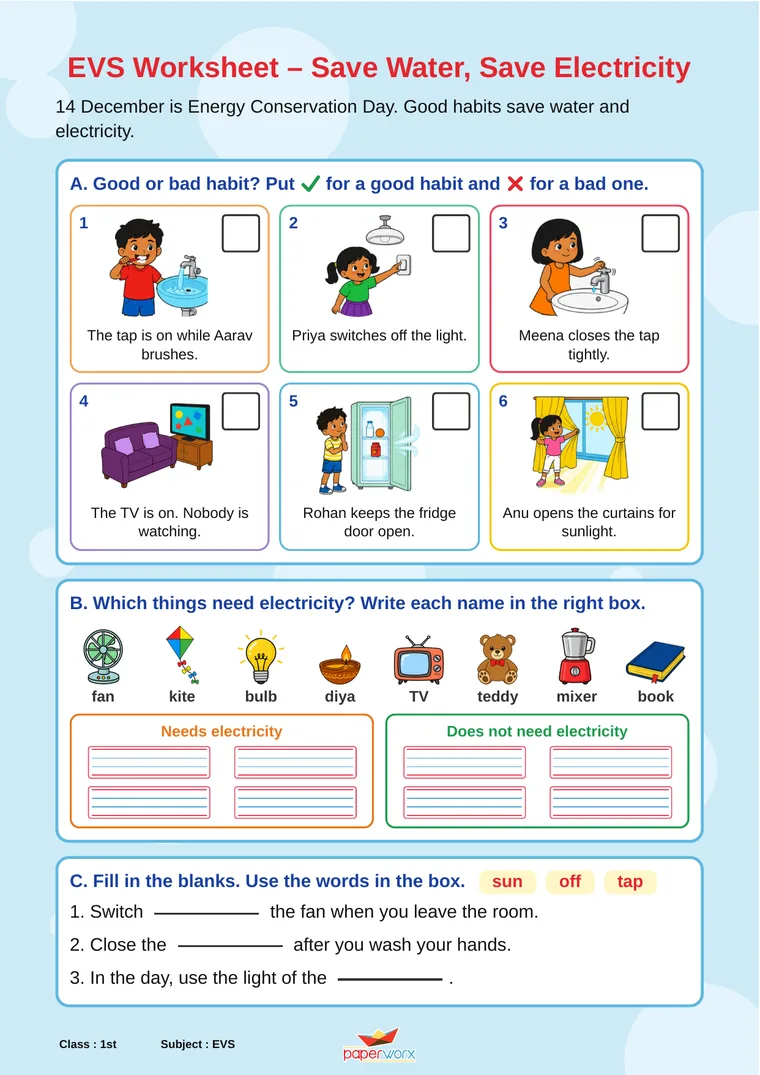
This Class 1 EVS sheet joins the good-habits and water lessons to National Energy Conservation Day on 14 December. Six coloured picture cards show children at home with a washbasin, a light switch, a TV, a fridge and a sunny window. A row of eight household things leads into a two-box sorting task on four-line rules, and three short fill-in sentences use a word box of sun, off and tap.
🇮🇳 Curriculum alignment
| NEP 2020 stage | Foundational Stage (NEP 2020) |
|---|---|
| Framework | NCF-FS 2022 |
Levelled using official national guidelines. How we level our worksheets
✏️ What your child will do
In Part A your child looks at six pictures – a tap left running while Aarav brushes, Priya switching off the light, Meena closing the tap, a TV playing to an empty sofa, Rohan at an open fridge and Anu opening the curtains – and puts a tick or a cross in each box. In Part B they sort eight things into "Needs electricity" and "Does not need electricity". In Part C they fill three blanks with sun, off and tap.
🎯 What your child will learn
- Telling a habit that saves water or electricity from one that wastes it, just by looking at a picture
- Knowing which things at home run on electricity (fan, bulb, TV, mixer) and which do not (kite, diya, teddy, book)
- Copying short words like fan, bulb, kite and diya correctly on four-line rules
- Reading a short sentence and filling the blank with off, tap or sun
- Knowing that 14 December is National Energy Conservation Day
👣 How to do it
- Read the line at the top together and talk about what saving water and electricity means in your home.
- In Part A, read the sentence under each picture and ask, "Is this saving or wasting?" Draw a tick or a cross in the box.
- In Part B, name all eight pictures aloud. For each one ask, "Does it need a switch or a plug?"
- Copy each name on the rules in the right box – four names go in each box.
- In Part C, try all three box words in each sentence and write the one that makes sense.
💡 Tips for parents
- Picture 3 still shows one drop falling from the tap, so some children mark it as wasteful. Read the sentence together – Meena is closing the tap tightly to stop that drip, which is a good habit.
- The diya gives light, so many children put it with the bulb. Ask, "Does it have a wire or a plug?" A diya needs oil and a wick, not electricity.
- In Part C, children often write "on" in sentence 1 because they know "switch on". The box has only "off" – and the words "when you leave the room" are the clue.
🌟 Try it at home
- Go on an "energy hunt" after dinner: walk through the house with your child, count the fans and lights left on in rooms where nobody is sitting, and let your child be the one who switches them off.
- Next time there is a power cut, talk about it together: which things stopped working, and which kept going – the gas stove, the diya, the matka of cool water, the cycle?
- Keep a small bucket in the sink while your child washes the vegetables for the sabzi, then let them carry that water to the tulsi or money plant instead of letting it go down the drain.
✅ Answer key
- Part A: 1. ✗ (tap left running while brushing) 2. ✓ (switching off the light) 3. ✓ (closing the tap tightly) 4. ✗ (TV on with nobody watching) 5. ✗ (fridge door left open) 6. ✓ (opening the curtains to use sunlight)
- Part B – Needs electricity: fan, bulb, TV, mixer. Does not need electricity: kite, diya, teddy, book.
- Part C: 1. off 2. tap 3. sun