
Factors and Multiples
No sign-up needed · How to print
No printer? Your child can write, draw and colour right on the screen – with a finger, a stylus or a mouse.
About this worksheet
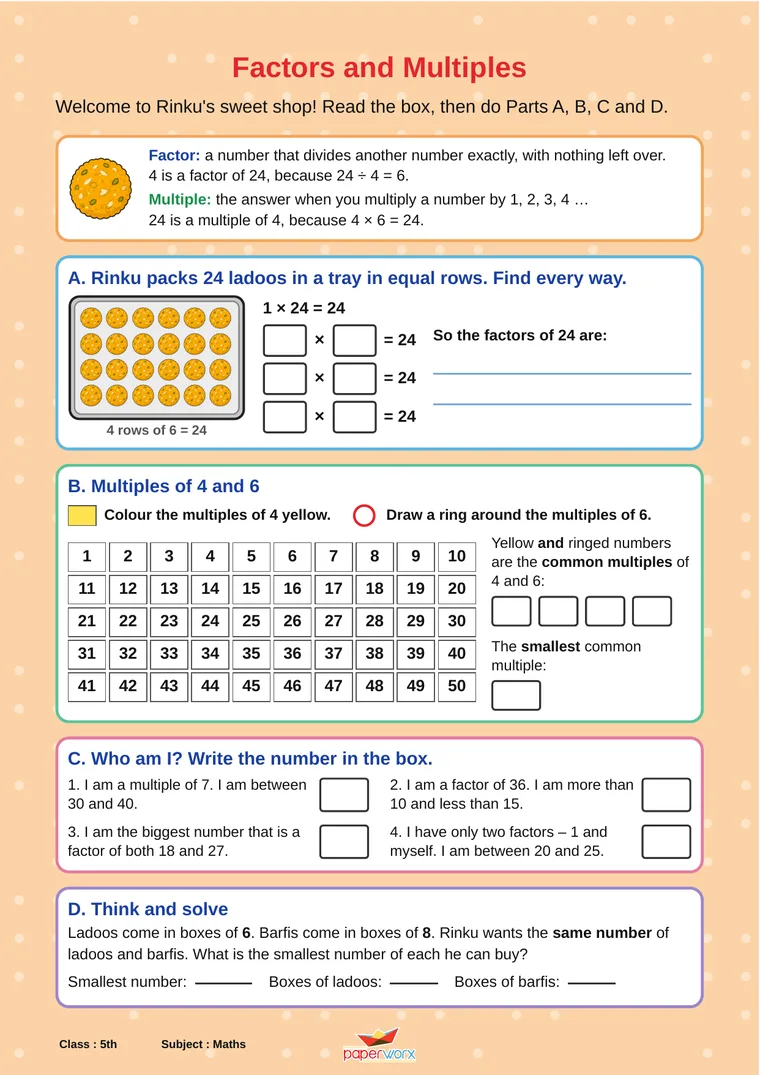
Factors and multiples worksheet for Class 5 Maths with a sweet shop theme: find all the factors of 24 from a ladoo tray, colour multiples of 4 and 6 on a 1–50 grid to find common multiples, solve four Who am I? riddles and a ladoo-and-barfi box problem. This free printable Class 5 Maths worksheet is made for children aged 10–11 years. It is levelled for the Preparatory Stage (NEP 2020) using NCF-SE 2023 guidelines and suits CBSE, ICSE and state board students. Use it for daily home practice, holiday homework, revision before tests or as a classroom activity. Download the A4 PDF for free – no sign-up needed – and print it in colour or black and white.
🇮🇳 Curriculum alignment
| NEP 2020 stage | Preparatory Stage (NEP 2020) |
|---|---|
| Framework | NCF-SE 2023 |
Levelled using official national guidelines. How we level our worksheets
✏️ What your child will do
A box explains factors and multiples with examples. In Part A your child looks at a tray of 24 ladoos in 4 rows of 6 and writes every other way to pack them in equal rows, then lists all the factors of 24. In Part B they colour the multiples of 4 and ring the multiples of 6 on a 1–50 grid and write the common multiples. Part C has four Who am I? number riddles, and Part D is a sweet shop problem about boxes of 6 ladoos and 8 barfis.
🎯 What your child will learn
- Finding factors of a number using equal rows (factor pairs)
- Listing multiples of a number on a number grid
- Finding common multiples and the smallest common multiple of two numbers
- Finding common factors of two numbers
- Knowing that a number with only two factors (1 and itself) is a prime number
- Using factors and multiples to solve a real-life shopping problem
👣 How to do it
- Read the box about factors and multiples.
- Part A: write the three other ways to make 24 (__ × __ = 24), then write all the factors of 24 on the lines.
- Part B: colour the multiples of 4 yellow and draw a ring around the multiples of 6. Write the numbers that are both, and the smallest one.
- Part C: read each riddle and write the number in the box.
- Part D: count in sixes and eights to find the smallest number of ladoos and barfis that can be the same, then work out the boxes.
💡 Tips for parents
- For Part A, give your child 24 buttons, beads or dry rajma beans and let them try to arrange them in equal rows. Every arrangement that works gives a factor pair.
- Factors come in pairs, so your child can stop checking when the pairs start to repeat (4 × 6 and 6 × 4 are the same pair).
- In Part B, the numbers that are both yellow and ringed are the common multiples. Point out that they are all in the 12 times table – 12 is the smallest one.
- Part D is the same idea in real life: count in sixes and in eights (6, 12, 18, 24… and 8, 16, 24…) until both lists reach the same number.
✅ Answer key
- Part A: 2 × 12 = 24, 3 × 8 = 24, 4 × 6 = 24 (any order). Factors of 24: 1, 2, 3, 4, 6, 8, 12, 24
- Part B: Multiples of 4 – 4, 8, 12, 16, 20, 24, 28, 32, 36, 40, 44, 48. Multiples of 6 – 6, 12, 18, 24, 30, 36, 42, 48. Common multiples: 12, 24, 36, 48. Smallest common multiple: 12
- Part C: 1. 35 2. 12 3. 9 4. 23
- Part D: Smallest number: 24 of each. Boxes of ladoos: 4 Boxes of barfis: 3