
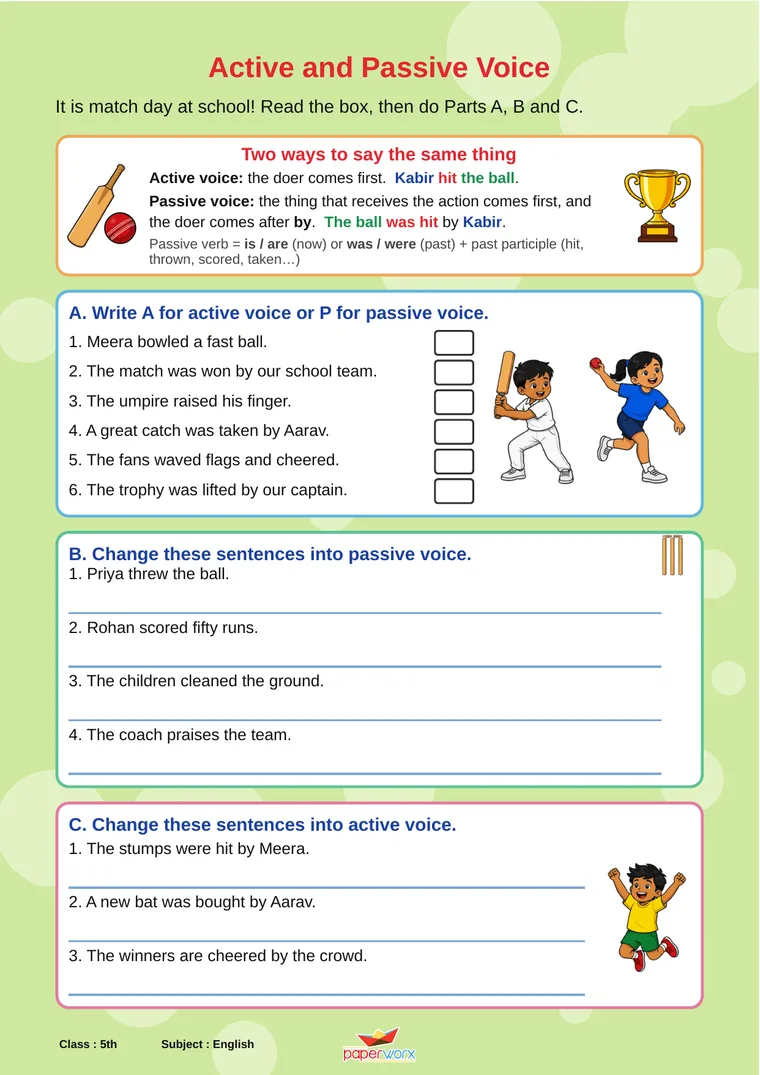
Active and Passive Voice
No sign-up needed · How to print
No printer? Your child can write, draw and colour right on the screen – with a finger, a stylus or a mouse.
About this worksheet
Active and passive voice worksheet for Class 5 English with a school cricket match theme: spot active and passive sentences, change four sentences into passive voice and three into active voice, using was/were and is/are with the past participle. This free printable Class 5 English worksheet is made for children aged 10–11 years. It is levelled for the Preparatory Stage (NEP 2020) using NCF-SE 2023 guidelines and suits CBSE, ICSE and state board students. Use it for daily home practice, holiday homework, revision before tests or as a classroom activity. Download the A4 PDF for free – no sign-up needed – and print it in colour or black and white.
🇮🇳 Curriculum alignment
| NEP 2020 stage | Preparatory Stage (NEP 2020) |
|---|---|
| Framework | NCF-SE 2023 |
Levelled using official national guidelines. How we level our worksheets
✏️ What your child will do
A rule box with colour-coded examples shows how "Kabir hit the ball" becomes "The ball was hit by Kabir". In Part A your child writes A or P for six sentences about a school cricket match. In Part B they rewrite four active sentences in the passive voice, and in Part C they rewrite three passive sentences in the active voice.
🎯 What your child will learn
- Telling active voice from passive voice
- Changing simple past and simple present sentences from active to passive voice
- Changing passive sentences back into active voice
- Choosing was/were and is/are to agree with the subject
- Using past participles such as thrown, scored, cleaned and praised
👣 How to do it
- Read the box and the coloured example sentences aloud.
- Part A: find who does the action in each sentence. Write A if the doer comes first, P if the sentence uses was/were … by.
- Part B: change each sentence into passive voice and write it on the line.
- Part C: change each sentence into active voice and write it on the line.
💡 Tips for parents
- Read the box together. Ask your child to find the doer in each example – who did the action? In active voice the doer starts the sentence; in passive voice the doer comes after "by".
- For Part B, use three quick steps: 1) move the object to the front, 2) add was/were (past) or is/are (present) with the past participle, 3) end with "by" and the doer.
- Watch the helping verb: "Fifty runs were scored" (plural) but "The ball was thrown" (singular). Ask your child to underline the new subject before choosing.
- Make it a game while watching a cricket match: say an active sentence like "The bowler took a wicket" and let your child turn it into the passive voice.
✅ Answer key
- Part A: 1. A 2. P 3. A 4. P 5. A 6. P
- Part B: 1. The ball was thrown by Priya. 2. Fifty runs were scored by Rohan. 3. The ground was cleaned by the children. 4. The team is praised by the coach.
- Part C: 1. Meera hit the stumps. 2. Aarav bought a new bat. 3. The crowd cheers the winners.