
Describing Words – Adjectives
No sign-up needed · How to print
No printer? Your child can write, draw and colour right on the screen – with a finger, a stylus or a mouse.
About this worksheet
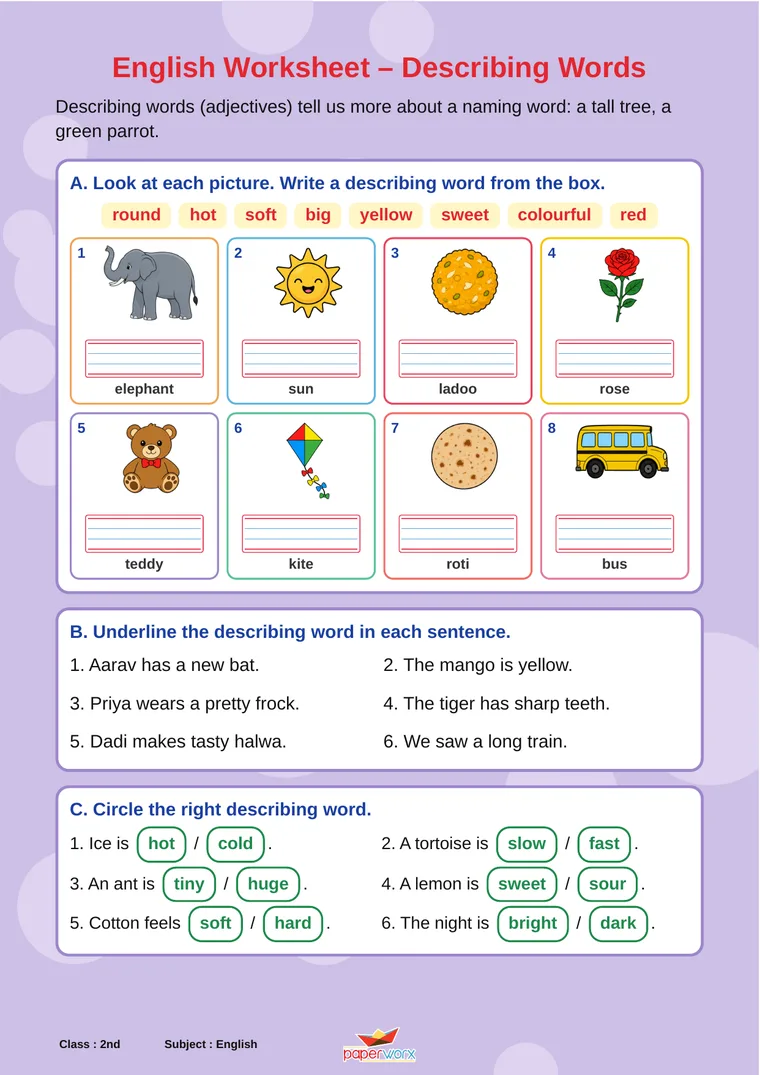
This Class 2 English sheet brings in adjectives as describing words, using everyday Indian pictures such as a ladoo, a roti, a kite and a yellow school bus. Part A has an eight-word box (round, hot, soft, big, yellow, sweet, colourful, red) with four-line rules under each picture. Part B has six short sentences with one adjective each, and Part C asks children to pick between pairs of opposite describing words.
🇮🇳 Curriculum alignment
| NEP 2020 stage | Foundational Stage (NEP 2020) |
|---|---|
| Framework | NCF-FS 2022 |
| NIPUN Bharat goal | Reads short sentences with understanding and writes simple words correctly |
Levelled using official national guidelines. How we level our worksheets
✏️ What your child will do
In Part A your child writes a describing word from the box under eight pictures – an elephant, the sun, a ladoo, a rose, a teddy, a kite, a roti and a school bus. In Part B they underline the adjective in six sentences about Aarav's bat, Priya's frock, a tiger, Dadi's halwa and a train. In Part C they circle the right word from pairs like hot/cold and sweet/sour.
🎯 What your child will learn
- Understanding that a describing word (adjective) tells us more about a naming word
- Choosing an adjective that fits a picture – its size, colour, taste, shape or feel
- Finding the one describing word in a short sentence
- Choosing between opposite adjectives such as hot/cold, slow/fast and tiny/huge
- Writing words neatly on four-line rules
👣 How to do it
- Read the line at the top with the examples "a tall tree, a green parrot" – ask what kind of tree and what kind of parrot.
- Read the eight box words aloud and name each picture in Part A.
- Write one box word on the rules under each picture and cross the word off in the box once it is used.
- In Part B, ask "what kind?" or "what colour?" about the naming word, then underline the answer.
- In Part C, read the sentence with each choice and circle the one that is true.
💡 Tips for parents
- In Part A the sun could also be "yellow" or "round", so children can get stuck. Each box word is used only once: do the sure ones first (ladoo – sweet, sun – hot) and the last few words fall into place.
- In Part B some children underline "a" or the naming word (bat, frock). Ask, "What kind of bat?" – the answer, "new", is the describing word.
- "The mango is yellow" puts the describing word after the naming word. Show your child that an adjective can come before the noun or after "is".
🌟 Try it at home
- At the sabzi mandi, ask your child to describe three vegetables with two describing words each – a long green lauki, small red tomatoes, a big round pumpkin.
- Play "Guess my fruit" at dinner: give three describing words like yellow, sweet and juicy, let your child guess the mango, then swap roles.
- Put five kitchen things in a cloth bag – a steel katori, a roti, an onion, a spoon, a ball of atta – and let your child feel each one with eyes closed and say a describing word: smooth, soft, round, cold.
✅ Answer key
- Part A: 1. big (elephant) 2. hot (sun) 3. sweet (ladoo) 4. red (rose) 5. soft (teddy) 6. colourful (kite) 7. round (roti) 8. yellow (bus)
- Part B: 1. new 2. yellow 3. pretty 4. sharp 5. tasty 6. long
- Part C: 1. cold 2. slow 3. tiny 4. sour 5. soft 6. dark